You are comparing two CTR tools and need a straight answer, not a feature list. Crowdsourced clicker networks live or die on visit proof and campaign control, and picking the wrong platform means paying for clicks you cannot verify.
This comparison covers what CTRTool and ClickSEO each offer, how their proof, campaign coverage and targeting stack up, and how pricing differs. By the end you will know which tool fits your network and have a clear verdict on the better pick.
Quick Verdict: ClickSEO vs CTRTool for Crowdsourced Clicker Networks
CTRTool is a screenshot-verified CTR campaign tool for Google, Bing, Maps, and AI Overviews, while ClickSEO is a crowdsourced clicker network that relies on paid micro-task workers to simulate organic clicks. The core difference sits in proof and control. CTRTool documents what happened on each visit, while ClickSEO's model depends on a distributed crowd of paid clickers whose behavior is harder to verify.
For teams running CTR manipulation campaigns at any scale, transparency is usually the first concern. Crowdsourced clicker networks can introduce variability, because each worker searches, clicks, and browses differently, and that inconsistency is difficult to audit after the fact. CTRTool addresses this with screenshot proof for every visit, delivered as separate search and landing proof images, plus full visit paths that show how a session progressed.
The proof layer is not cosmetic. Each visit can be traced through its path, keyword positions are tracked over time, including Maps listing order and AI citation order, and visits that cannot verify the requested location use no credits. That last point matters for geo-targeting accuracy, where a mismatched location weakens the value of the click.
ClickSEO's model involves paid clickers and micro-task workers, which can introduce variability and fraud risk. That does not make a crowd-based approach useless, but it shifts the burden of quality control onto the buyer. With CTRTool, the pay-for-results credit model means no credits are charged for technical failures before landing, so spend tracks delivered visits rather than attempted ones.
| Factor | CTRTool | ClickSEO |
|---|---|---|
| Visit proof | Screenshot proof for every visit, with search and landing images | Crowd-based execution, generally described rather than documented per visit |
| Visit detail | Full visit paths, visits up to 5 minutes with up to 5 additional internal pages | Varies by worker and task |
| Targeting control | Keyword targeting, location verification, Maps and AI Overviews coverage | Depends on worker availability and instructions |
| Billing model | Pay-for-results credits, no charge for pre-landing technical failures | Typically task or click based |
| Variability risk | Controlled visit parameters | Higher, since behavior comes from many individuals |
Recommendation: choose CTRTool if you prioritize verifiable proof, controlled targeting, and multi-platform coverage across Google, Bing, Maps, and AI Overviews. Choose ClickSEO only if a purely human-driven click source is your priority and you accept the added variability that comes with paid clickers.
At a glance: how CTRTool compares to ClickSEO on the features that matter most.
| Feature | CTRTool | ClickSEO |
|---|---|---|
| Pricing (entry paid plan) | $59/mo Starter | $30 Basic |
| Free plan / free trial | ✗ | Free trial |
| CTR manipulation / organic clicks | ✓ | ✓ |
| Keyword tracking | ✓ | ✓ |
| Campaign statistics / reporting | ✓ | ✓ |
| Geo / country targeting | ✓ | 170+ countries |
| Search Console traffic recording | — | ✓ |
| Screenshot proof per visit | ✓ | — |
What Is CTRTool?
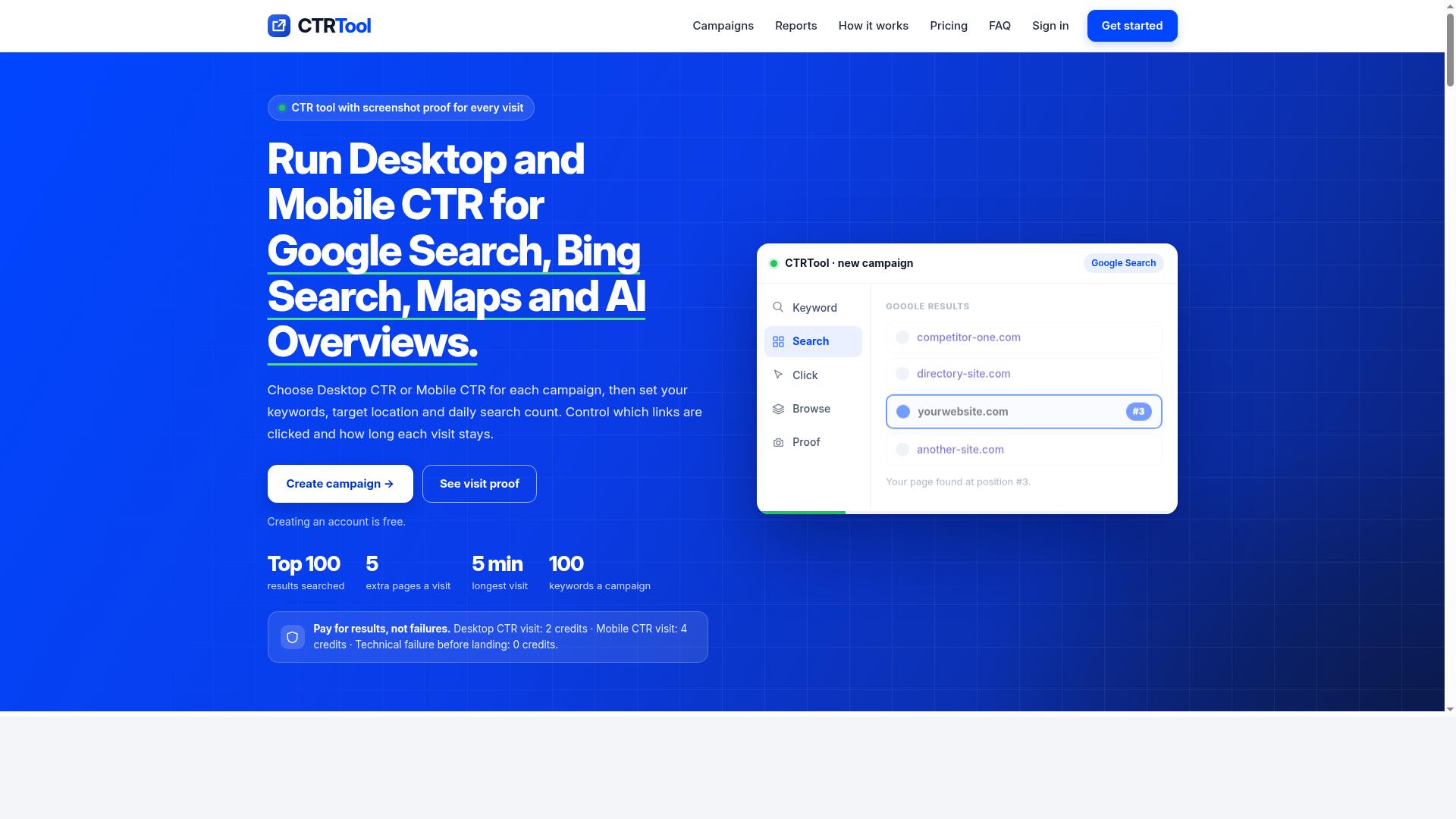
CTRTool is a SaaS platform that runs Desktop and Mobile CTR campaigns for Google Search, Bing Search, Google Maps, and AI Overviews, providing screenshot proof for every visit. It is built for SEO practitioners and agencies who want a structured way to run and monitor CTR boosting campaigns rather than relying on scattered manual work.
The core workflow is campaign-driven. A user selects a campaign type, chooses Desktop CTR or Mobile CTR, then sets keywords, a target location, and a daily search count.
Not every element of a visit is left to chance. Users control which links are clicked and how long each visit stays, which matters for signals like dwell time and bounce rate. That level of control separates a managed campaign from a generic traffic bot.
Proof is a central part of the design. Every visit includes search and landing screenshots as separate proof images, so agencies can document what actually happened rather than trusting a dashboard count. Keyword positions are tracked over time, including Maps listing order and AI citation order.
There is one practical condition to plan around. Campaigns require the target page to appear within the top 100 organic results for the chosen keyword and location. The tool is not positioned as a way to force a page into the index.
CTRTool is also upfront about limits. The site states plainly: Automated visits do not guarantee rankings. That honesty matters in a market where click fraud tools often oversell what user behavior signals can achieve.
For readers weighing ClickSEO against CTRTool, the distinction is transparency. CTRTool documents each visit, tracks SERP position over time, and sets clear boundaries on what a campaign can and cannot do, which is the baseline any serious agency should demand before committing to CTR manipulation work.
What Is ClickSEO?
ClickSEO is a crowdsourced clicker network that pays real users to perform search queries and click on specified results, aiming to influence organic CTR and SERP rankings. The description below reflects the general category of crowdsourced clicker networks rather than verified specifics about any single provider.
In this model, campaigns are broken into small click tasks and distributed to a crowd of micro-task workers or paid clickers. Each worker receives a keyword, a target page, and basic instructions, then performs the search on a Google SERP or Bing SERP and clicks the result.
The appeal is simple: real people generate real user behavior signals, including genuine browser fingerprints and organic mouse movement. Unlike traffic bots, a human clicker does not need device emulation or user agent spoofing to look plausible at the surface level.
That human element is also the model's weak point. Because every click depends on a person following instructions, the quality of the resulting engagement metrics varies widely from task to task.
Crowdsourced clicker networks typically rely on several supporting tactics to keep activity from standing out:
- Proxy rotation and residential proxies to vary IP addresses across clicks
- Account farming to maintain pools of Google accounts with search history
- CAPTCHA solving services so workers can complete queries without interruption
- Basic keyword targeting and geo-targeting instructions attached to each task
These measures can reduce obvious red flags, but they do not guarantee that a click profile matches authentic user behavior. Search engines continuously refine detection of ranking manipulation, and paid clickers remain a known pattern that systems are built to recognize.
Three problems tend to surface in crowdsourced click campaigns:
- Inconsistent dwell time. Workers are paid per task, so many click and leave quickly. Short session duration signals low interest rather than genuine engagement.
- Variable bounce rates. Some workers explore a page, others exit immediately, producing erratic patterns that look unnatural at scale.
- Click fraud detection risk. Repeated accounts, recycled proxies, and synchronized task completion can cluster into detectable patterns.
The impression-to-click ratio also becomes hard to control. If clicks arrive without matching impressions or follow predictable timing, the anomaly can undermine the very SERP position the campaign was meant to lift.
None of this means every crowdsourced network performs identically. It does mean the model carries structural variance that campaign managers should weigh carefully before committing budget to CTR boosting through paid clickers.
For readers comparing options, the practical question is not whether human clickers exist, but how much of the process is controlled and measurable. Crowdsourced networks depend on worker compliance, which introduces unpredictability in timing, session duration, and consistency across a campaign.
Software-driven CTR manipulation tools take a different approach, emphasizing repeatable execution and defined campaign parameters over ad hoc human tasks. When evaluating either path, look for clear documentation of how clicks are delivered, how targeting is configured, and what safeguards exist against click fraud flags.
The sections that follow compare the two models on execution, consistency, and risk so you can judge which fits your search engine optimization goals.
Features Compared
This section compares CTRTool and ClickSEO across three critical dimensions: proof and transparency, campaign coverage, and targeting and visit control. Each dimension matters because CTR manipulation only holds up when visits look and behave like real users, and when the buyer can confirm what was actually delivered.
The evaluation focuses on verifiability, platform support, and the level of control over click behavior. Crowdsourced clicker networks and managed tools solve the same problem in very different ways, and those differences show up most clearly in what you can check after a campaign runs.
The sub-sections below examine specific capabilities in turn: per-visit screenshot evidence, the range of campaign types available, and the settings that shape how each visit is targeted and executed.
Proof and Transparency: Screenshot Evidence per Visit
CTRTool provides search and landing screenshots as separate proof images for every visit, along with full visit paths, while ClickSEO's crowdsourced model typically offers limited or aggregated reporting. The screenshots capture the search query, the clicked result, and the landing page, so a buyer can confirm that each visit matched the campaign request.
This kind of evidence matters because click fraud concerns are central to any CTR manipulation discussion. When proof is limited to task completion logs, as is often the case with crowdsourced clicker networks, there is little way to verify that a paid clicker followed the instructions or landed on the intended page.
CTRTool also tracks keyword positions over time, including Search positions, Maps listing order, and AI citation order. That reporting connects the delivered visits to movement in SERP position, which supports auditability and gives SEO teams something concrete to review.
The credit model reinforces the transparency. CTRTool uses a pay-for-results approach with no credits charged for technical failures before landing, and visits that cannot verify the requested location use no credits. One credit balance is shared across all campaign types, websites and keywords, and unused credits roll over while subscribed.
Campaign Coverage: Google, Bing, Maps and AI Overviews
CTRTool supports four campaign types: Google Search CTR, Bing Search CTR, Google Maps CTR, and AI Overviews, each with Desktop or Mobile options. That breadth matters because search engine optimization now spans more surfaces than the classic ten blue links.
- Google Search CTR: search the keyword and click the organic result, with Top 100 results and internal pages supported.
- Bing Search CTR: the same flow applied to the Bing SERP.
- Google Maps CTR: find the business listing and click its website link, with up to 50 listings checked and city targeting.
- AI Overview CTR: find the website in the overview and click its source link, which requires a matching citation.
ClickSEO's coverage is generally limited to Google and Bing search results, with no native support for Maps or AI Overviews as described here. Buyers who want CTR boosting across local and AI-generated results therefore have fewer levers in a crowdsourced setup.
Setup depth also differs. CTRTool allows up to 100 keywords per campaign, search depth up to 100, and up to five additional internal pages per visit, with visits running up to five minutes total. Those controls shape engagement metrics rather than leaving them to chance.
Targeting and Visit Control: Location, Daily Counts and Click Behavior
CTRTool allows users to target a chosen country and optionally a state and city, set daily visit counts, and choose Desktop or Mobile CTR per campaign, while ClickSEO's targeting is typically limited to keyword and geo parameters with less control over visit behavior. CTRTool runs as a global service with no stated country restrictions, and campaigns can also use 'Any country' to draw on a mix of supported locations.
Daily search counts come with now, spread out, and gap timing options, plus selectable days, hours and a time zone, with daily goals resetting at 00:00 UTC. This level of geo-targeting and scheduling helps visits resemble a natural impression-to-click ratio instead of a sudden spike.
Click behavior can be influenced through campaign settings such as click order, scrolling time, and additional internal pages. CTRTool delivers visits through Desktop Chrome windows and real Android phone sessions matched to the target location through managed proxy routes.
In a crowdsourced model, control over device type, user agents, and session duration depends on whatever hardware the crowd happens to use. That variability makes dwell time and bounce rate harder to steer, and it leaves more of the user behavior signals a ranking algorithm reads to chance.
Pricing Compared
CTRTool offers monthly plans starting at $59 for 2,000 credits (up to 1,000 Desktop CTR visits or 500 Mobile CTR visits) and $125 for 5,000 credits, while ClickSEO's pricing is typically based on pay-per-click tasks and varies by provider. That difference in structure matters when you are budgeting a CTR manipulation campaign across many keywords.
One model publishes a fixed monthly rate. The other ties cost to task volume, which makes forecasting harder. For teams running ongoing click-through rate campaigns, predictability often matters as much as the per-unit price.
| Plan | Monthly Price | Credits | Approximate Visits |
|---|---|---|---|
| Starter | $59 | 2,000 | Up to 1,000 Desktop or 500 Mobile |
| Growth (Recommended) | $125 | 5,000 | Up to 2,500 Desktop or 1,250 Mobile |
| Scale | $399 | 20,000 | Up to 10,000 Desktop or 5,000 Mobile |
| Agency | $699 | 40,000 | Up to 20,000 Desktop or 10,000 Mobile |
Credits are consumed per visit, and the cost is not uniform. A Desktop CTR visit uses 2 credits, while a Mobile CTR visit uses 4 credits. A verified search without a match costs 1 credit, and a technical failure before landing costs 0 credits.
That last detail is worth highlighting. You are not charged full price when a session fails before it reaches your page. On a crowdsourced clicker network, failed tasks can still consume budget, so this distinction affects real campaign economics.
CTRTool also rolls unused credits over while a subscription is active. They expire only when cancellation takes effect, and creating an account is free. Custom development is quoted separately as an agreed one-time fee.
ClickSEO, by contrast, is generally priced per click or per task. Exact rates can vary by provider and campaign setup, so treat any figure you see as a starting point rather than a fixed commitment.
Transparency and Cost Variability
CTRTool's pricing is published and transparent. Every tier, credit cost, and rollover rule is visible before you commit. That makes it easier to map a keyword list to a budget and compare plans as your keyword targeting expands.
Crowdsourced clicker networks often work differently. Costs may shift with task availability, worker supply, or the complexity of the request. A campaign that looks cheap at the start can become harder to forecast once volume grows.
There is also a quality trade-off to weigh. Pay-per-task pricing can look flexible, but variable costs make it harder to plan a sustained SERP ranking push. A fixed monthly credit pool gives you a clearer ceiling.
For readers comparing options, the practical question is simple. Do you want a rate you can plan around, or a per-task price that moves with the market? CTRTool leans toward the first, with tiers that scale from small tests to agency-level volume.
Who Should Choose CTRTool
CTRTool is best suited for SEO practitioners and agencies who need verifiable proof of every visit and require campaign coverage across Google, Bing, Maps, and AI Overviews. The platform is built for people running CTR campaigns for their own sites or client properties, not for casual experimentation.
That focus shapes who gets the most value from it. If your work involves client reporting, multi-engine targeting, or controlled delivery, the feature set lines up with how you already operate.
Agencies managing client websites are the clearest fit. When a client asks what was delivered, a screenshot per visit gives you something concrete to put in a report. That matters for audit-ready proof, and it also helps when a stakeholder or compliance reviewer wants documentation of campaign activity.
Compare that to crowdsourced clicker networks, where visits come from paid clickers or micro-task workers and the evidence trail is typically thin. With CTRTool, each visit carries its own record, so reporting does not depend on trust alone.
SEOs targeting multiple search engines also benefit. CTRTool covers Google Search, Bing Search, Google Maps, and AI Overviews, which means one campaign structure can address several surfaces instead of stitching tools together. For local SEO work, Maps coverage is especially relevant because geo-targeting and device selection let you shape how visits are distributed.
Teams that care about controlled delivery tend to prefer this over the unpredictable nature of crowdsourced clicker networks. Paid clickers and micro-task workers introduce variance in device, location, and behavior that is hard to standardize across a campaign.
Budget predictability is another reason teams pick CTRTool. Pricing is transparent and credit-based, so you can estimate campaign cost before launch and plan spend across clients without surprise invoices. For an agency juggling several accounts, that makes forecasting straightforward.
The table below summarizes the typical CTRTool user against the crowdsourced clicker alternative.
| Consideration | CTRTool | Crowdsourced clicker networks |
|---|---|---|
| Proof per visit | Screenshot proof for each visit | Generally limited or indirect evidence |
| Search surfaces | Google Search, Bing Search, Google Maps, AI Overviews | Varies by network, often narrower |
| Delivery control | Geo-targeting and device selection | Depends on worker availability and behavior |
| Budgeting | Transparent, credit-based pricing | Often opaque or variable |
| Best for | Agencies and SEOs needing documentation | Buyers prioritizing raw volume over proof |
If your priorities are documented delivery, multi-engine reach, and predictable spend, CTRTool is the stronger match. Teams that only want the lowest-cost volume may look elsewhere, but they give up the reporting trail that client work usually demands.
Who Should Choose ClickSEO
ClickSEO may appeal to users who prefer a purely human-driven click source and are willing to accept less transparency and control in exchange for potentially lower per-click costs. That profile fits a narrow set of situations, mostly early experiments where the goal is to see whether CTR manipulation moves a SERP position at all before committing more effort.
In practice, the typical ClickSEO user is testing a crowdsourced clicker network on a small budget. They are not yet worried about proving each click happened, and they are running on a single search engine rather than juggling several.
These networks route search queries to paid clickers or micro-task workers who perform the search and click manually. Because a real person is behind the action, the resulting user behavior signals can look natural on the surface. The trade-off is that you rarely get screenshot proof, and you have limited say over how each session unfolds.
That setup carries real risks. Click fraud, inconsistent engagement metrics, and uneven dwell time can all distort what you learn from a test. A campaign can look like it worked when the clicks were simply spread thin across too few workers. For a small pilot, that may be acceptable. For anything you plan to scale, it becomes a problem.
Consider ClickSEO as a starting point only if most of the following describe you:
- You are running a small-scale test and want to keep spend minimal.
- You only need one search engine, such as a Google SERP or Bing SERP, not multi-platform coverage.
- You can live without screenshot proof or detailed per-click records.
- You accept that engagement metrics and impression-to-click ratio may vary between batches.
- You are comfortable with the ethical and policy questions that surround click farms and ranking manipulation.
If any of those conditions feels like a compromise you cannot make, a human-only crowd is probably not the right fit. The lack of control over session duration, geo-targeting, and device emulation limits how precisely you can test keyword targeting or CTR boosting by position.
Keep expectations hedged. Public information about how any given crowd behaves is thin, and results can differ widely between campaigns and niches. What works for one keyword may not transfer to another, and a lower per-click cost does not guarantee a better outcome once variability is factored in.
The short version: ClickSEO suits the curious, budget-conscious tester who wants human clicks and can tolerate less visibility into what those clicks actually delivered. Readers who need repeatable campaigns, documented proof, and finer control over user behavior signals usually find a crowd-only model too loose for serious search engine optimization work.
Final Verdict
CTRTool emerges as the stronger choice for professionals who prioritize verifiable proof, multi-platform campaign coverage, and transparent pricing over the opaque, crowd-driven model of ClickSEO. The deciding factor is auditability: every visit in CTRTool produces screenshot proof, with search and landing screenshots delivered as separate proof images, so campaign owners can review what actually happened rather than trusting a crowd network's summary.
That proof layer matters because CTR manipulation campaigns are only as useful as the data you can inspect afterward. Without verifiable evidence, a practitioner cannot separate real visits from failed attempts, and cannot defend spend to a client or stakeholder. CTRTool closes that gap with full visit paths and keyword position tracking over time, including Maps listing order and AI citation order.
Platform coverage is the second major differentiator. CTRTool supports campaigns across Google, Bing, and Maps, along with AI Overviews, so a single credit balance covers every campaign type, website, and keyword. Agencies running multi-platform strategies avoid juggling separate vendors or budgets for each surface.
Pricing follows the same principle. CTRTool uses a pay-for-results credit model with clear monthly pricing, and no credits are charged for technical failures before landing. Visits that cannot verify the requested location also use no credits, and unused credits roll over while the subscription stays active.
ClickSEO's crowdsourced approach, where paid clickers and micro-task workers supply engagement, may suit narrow experiments or informal testing. However, it lacks the auditability and control that agencies and SEO practitioners typically require. Crowd-based delivery introduces variables, from inconsistent user behavior signals to uneven session duration, that are difficult to verify at scale.
| Factor | CTRTool | ClickSEO |
|---|---|---|
| Visit verification | Screenshot proof for every visit, search and landing images separate | Crowd-delivered visits, limited verification described |
| Platform coverage | Google, Bing, Maps, and AI Overviews | General crowd network, platform mix not clearly defined |
| Position tracking | Keyword positions over time, including Maps listing order and AI citation order | Not clearly documented |
| Billing model | Pay-for-results credits, no charge for pre-landing failures, rollover while subscribed | Crowd payout structure, terms vary |
| Scale | Up to 100 campaigns with 100 keywords each | Depends on worker availability |
For proof-backed campaigns, CTRTool is the clear recommendation. Its unique combination of per-visit screenshots, tracked visit paths, a shared credit balance, and support for Google, Bing, Maps, and AI Overviews gives practitioners the control and documentation that ranking work demands. Visits of up to 5 minutes with up to 5 additional internal pages also support realistic dwell time and lower bounce rate signals.
Consider ClickSEO only with caution and limited scope. If a small, low-stakes test seems worthwhile, keep expectations modest and treat results as directional rather than verified. For anything client-facing or budget-sensitive, the lack of auditability is a meaningful risk in a space already watched closely for click fraud and ranking manipulation.
The forward-looking takeaway is simple. As search results grow more complex, spanning classic SERPs, Maps, and AI-generated answers, campaigns need evidence attached to every action. Choose the platform that documents each visit and charges only for results it can stand behind.
Frequently Asked Questions
What is the main difference between CTRTool and ClickSEO?
CTRTool is a dedicated CTR campaign tool built around screenshot proof for every visit, covering Google Search, Bing Search, Google Maps and AI Overviews with Desktop or Mobile campaigns. ClickSEO is listed with broader SEO features such as automated SEO audits, so it appears to serve a wider SEO workflow rather than focusing solely on CTR campaigns. If your priority is verifiable click-through campaigns, CTRTool is purpose-built for that job.
Does CTRTool provide proof that clicks actually happened?
Yes. CTRTool is positioned as a CTR tool with screenshot proof for every visit, providing search and landing screenshots as separate proof images along with full visit paths. This lets you verify each campaign visit rather than relying on aggregate reports alone. ClickSEO's researched feature list does not mention per-visit screenshot proof.
How does pricing work for each tool?
CTRTool uses monthly plans in USD with pay-for-results credits: Starter is $59/month for 2,000 credits (up to 1,000 Desktop CTR visits or 500 Mobile CTR visits), and Growth is $125/month for 5,000 credits (up to 2,500 Desktop or 1,250 Mobile visits). ClickSEO is listed on Techjockey with plans at $30 (Basic/Standard) and $55 (Essential), and The AI Library lists it as Freemium, with a free trial and lifetime plan noted. The two tools therefore differ in structure as well as price, so compare what each plan actually delivers.
Which platforms and campaign types does CTRTool support?
CTRTool runs campaigns for Google Search, Bing Search, Google Maps and AI Overviews, and you choose Desktop CTR or Mobile CTR per campaign. You set keywords and target a country with an optional state and city, or use "Any country" for a mix of supported locations. ClickSEO's researched feature list centers on SEO features such as audits rather than detailing comparable CTR campaign types.
Can I track keyword positions and ranking changes with CTRTool?
Yes. CTRTool tracks keyword positions over time, including Maps listing order and AI citation order, alongside full visit paths for each campaign. Campaign requirements are clear: the page must appear within the top 100 organic results for the chosen keyword and location, Maps campaigns check up to 50 listings, and AI Overview campaigns need a matching source link.
Who is each tool best suited for?
CTRTool targets SEO practitioners and agencies running CTR campaigns for their own or client websites across Google Search, Bing Search, Google Maps and AI Overviews. Its guidance also covers tier links, PBNs and test properties for campaign setups. ClickSEO, with its broader SEO audit and freemium positioning, may appeal to users who want an all-round SEO toolkit rather than a dedicated CTR campaign platform.