You are comparing SalesRabbit and Veloxy to track your team's Salesforce activity, but the two tools measure completely different things. Your choice comes down to whether you need manual territory logging or AI-driven pipeline visibility. By the end of this article, you will know exactly which platform fits your team tracking workflow.
You will see how each tool handles Salesforce-native adoption, pipeline forecasting, and real-time buying signals. We will also break down the pricing differences and give you a direct verdict on who should pick Veloxy and who should stick with SalesRabbit.
Quick Verdict: SalesRabbit vs Veloxy for Team Tracking
For teams that live in Salesforce, Veloxy offers native team tracking and AI-driven prioritization, while SalesRabbit provides a standalone field sales platform with manual territory logging. The core difference comes down to where your team already works. Veloxy is built exclusively for field reps who use Salesforce, so manager view, sales activity, and pipeline visibility all live inside the CRM your team already opens daily.
SalesRabbit, by contrast, is a dedicated field sales app that tracks GPS location and check-ins independently. That works well for teams without a strong CRM foundation, but it means extra data entry and a second system to maintain. For Salesforce-centric teams, Veloxy eliminates that overhead entirely.
On pricing, Veloxy runs at $65 per user per month. SalesRabbit typically lands around $50 per user per month, though that figure is not independently verified and can vary by plan. The small price gap disappears quickly when you consider that Veloxy customers report doubling sales productivity and pipeline within three months, according to verified brand data.
Choose SalesRabbit if you need a standalone tool with GPS tracking and no CRM dependency. Choose Veloxy if your team already operates inside Salesforce and wants AI-driven buying signals, real-time tracking, and a leaderboard without leaving the platform.
At a glance: how Veloxy compares to SalesRabbit, Veloxy for Team Tracking on the features that matter most.
| Feature | Veloxy | SalesRabbit | Veloxy for Team Tracking |
|---|---|---|---|
| Team Tracking | ✓ | ✓ | ✓ |
What Is Veloxy?
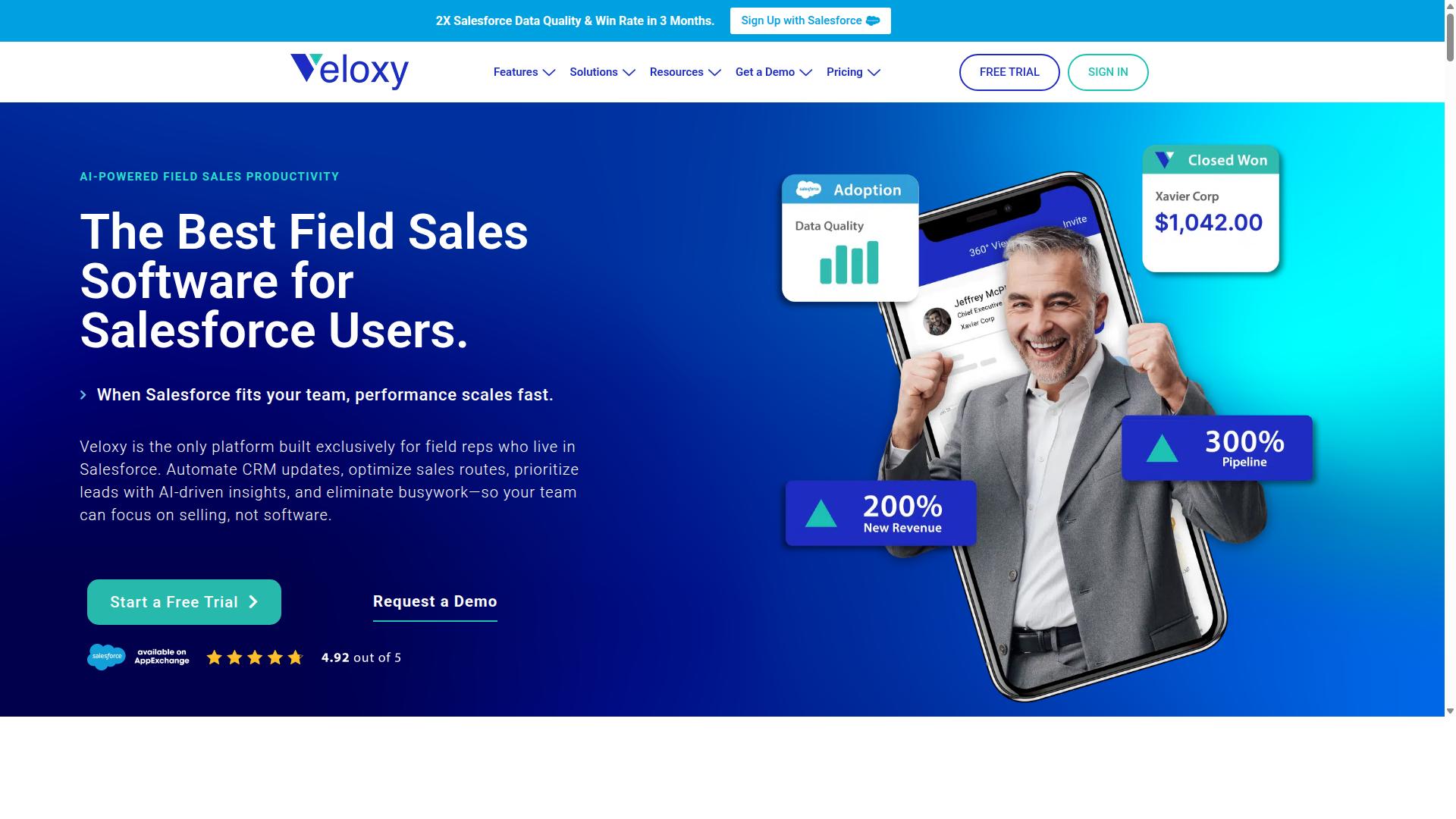
Veloxy is an AI-powered sales enablement and predictive forecasting software built exclusively for Salesforce CRM users, designed to help field sales reps engage more effectively and double their sales productivity within three months. The platform is built specifically for sales teams that live inside Salesforce, which makes it a natural fit for organizations already committed to that CRM ecosystem.
Its target audience spans field sales, inside sales, and sales management. Field reps get the context they need while on the move, while managers gain better visibility into what actually drives the pipeline. The mission behind Veloxy is straightforward: help sales reps get more out of Salesforce than they put in, while giving management more accurate forecasts and analytics to see which actions truly move deals forward.
Veloxy automatically logs key sales activities like calls, emails sent, opens, and replies. This makes it painless to maintain CRM data on the go, since data entry becomes a natural step in the sales workflow rather than a separate chore. The software feeds reps the right data at the right time based on their context, location, and upcoming events, so they can focus on priorities without hunting for information.
Key features include Salesforce Automation, Buying Signals, Lead Qualification, Pipeline Management, Sales Analytics, a Quick Dialer, and Guided Selling. Veloxy Analytics gives sales managers and operations teams more accurate forecasts based on historical analysis of individual biases, plus tools to examine how different sales activities correlate to pipeline growth. The platform is available globally and integrates entirely within Salesforce, making it a strong option for teams that want deeper CRM adoption without switching tools.
What Is SalesRabbit?
SalesRabbit is a field sales management platform that focuses on territory mapping, route optimization, and GPS tracking, designed for sales teams that need a standalone solution without deep CRM integration. It is built for reps who spend most of their time on the road, knocking on doors, or visiting prospects in person rather than working from a desk.
The platform provides tools for planning efficient travel between appointments, which helps sales reps cover more ground in less time. Territory management features allow managers to divide geographic areas among team members, while GPS tracking gives supervisors visibility into where their reps are during the workday.
SalesRabbit also includes leaderboards and gamification elements to encourage friendly competition among team members. These features can boost motivation, particularly for field sales organizations that rely on high-volume prospecting and daily visit targets.
One key characteristic is that SalesRabbit is not Salesforce-native. It operates as a standalone application that can connect with popular CRMs like Salesforce, HubSpot, and Microsoft Dynamics, but the integration layer requires configuration and ongoing maintenance. For teams already working extensively inside Salesforce, this extra step can create friction in their daily workflow.
In short, SalesRabbit suits organizations that want a dedicated field sales tool with strong mapping and location capabilities. However, teams that prioritize seamless CRM integration and real-time pipeline visibility may find the standalone approach limiting when comparing options for team tracking.
What Is Veloxy for Team Tracking?
Veloxy for team tracking leverages Salesforce-native features to provide real-time visibility into sales activities, including GPS tracking, check-ins, and activity feeds, all within the Salesforce interface. Because Veloxy is built directly on Salesforce, it does not require your team to learn a separate platform or switch between tools. This Salesforce-native design is a major reason adoption tends to be higher, since sales reps can keep working in the CRM they already use every day.
Managers get a dedicated view of team performance that pulls from live Salesforce data. Instead of waiting for end-of-day reports, you can see where each sales rep is, whether they have checked in or out, and what activities they have logged. The system supports real-time location tracking and activity feeds, which makes it easier to spot coaching opportunities or productivity gaps as they happen.
Veloxy also adds a competitive layer to team tracking through leaderboards and performance metrics. These features are part of a broader field sales toolkit that includes Salesforce Automation, Sales Analytics, Smart Forecasts, and an Opportunity Map. For teams already invested in Salesforce, Veloxy turns the CRM into a complete team tracking and management hub without adding another disconnected piece of software.
Features Compared
This section breaks down the feature sets of Veloxy and SalesRabbit, focusing on team tracking, pipeline visibility, and prioritization capabilities. Both tools aim to help field sales teams work smarter, but they take very different approaches under the hood.
The core difference comes down to where the work happens. Veloxy lives inside Salesforce, while SalesRabbit operates as a separate platform. That single distinction shapes everything from daily adoption to the quality of data managers see.
Salesforce-Native Team Tracking & Adoption
Veloxy's team tracking is built directly into Salesforce, meaning reps don't need to switch apps, which significantly boosts adoption rates. Managers can see activities, check-ins, and GPS locations without ever leaving the CRM they already use daily. This removes the friction that typically kills sales tools.
SalesRabbit, by contrast, requires reps to open a separate application to log their field activity. That extra step often leads to lower engagement over time, as reps forget to update or simply skip the process. For sales leaders, incomplete data makes it harder to trust the dashboard.
Veloxy's AI assistant also saves meaningful time for reps. Comcast's Sonny Hawkins reports saving 60+ minutes a day using Veloxy's AI Sales Assistant software, which he credits with improving Salesforce adoption and overall sales engagement. When reps get time back, they spend it selling instead of doing data entry.
AI-Driven Pipeline Visibility vs. Manual Territory Logging
Veloxy uses AI to automatically update pipeline stages and predict deal progress, while SalesRabbit relies on manual territory logging by reps. This means Veloxy reduces the administrative burden on sales teams, letting them focus on customer conversations rather than data cleanup.
With Veloxy, managers get a live view of the sales pipeline without chasing reps for updates. The system tracks deal movement and surfaces what matters, so forecasting becomes less about guesswork and more about actual signals. SalesRabbit's approach depends heavily on how consistently reps log their visits and territory details, which can vary widely from person to person.
The efficiency gain is substantial. Veloxy customers report doubling their sales productivity within three months of adoption. When reps stop wrestling with manual logging, they redirect that energy toward pipeline growth and revenue-generating activities.
Real-Time Buying Signals for Team Prioritization
Veloxy provides real-time buying signals that help sales teams prioritize leads and focus on prospects showing high engagement, a feature SalesRabbit lacks. These signals analyze prospect behavior such as email opens and clicks, giving reps a clear sense of which deals deserve immediate attention.
For managers, this creates a smarter lead assignment process. Instead of distributing leads evenly or by gut feel, team leads can route high-intent prospects to the reps best positioned to close them. This is part of Veloxy's AI sales assistant, which is designed to surface the most actionable insights without requiring manual research.
SalesRabbit does not offer comparable AI-driven signals, so reps must rely on their own judgment about which prospects are warming up. That approach can work, but it leaves room for missed opportunities. Veloxy's Buying Signals feature removes that guesswork, helping teams focus their energy where it counts most.
Pricing Compared
Veloxy offers transparent per-user pricing at $65/month with discounts for annual or multi-year commitments, while SalesRabbit's pricing is less public and typically varies by team size. This transparency makes it easier for sales teams to budget accurately without scheduling sales calls just to get a basic quote.
With Veloxy, you can save 25% with an annual subscription or save 50% with a 3-year commitment. That brings the effective cost down to roughly $32 per user per month on the longest term. For growing teams, Veloxy also offers company plans at $899/mo for 25 team members, with an annual plan that saves 45%.
SalesRabbit does not publicly disclose its pricing, so you cannot compare exact numbers without requesting a custom quote. Pricing there typically depends on team size, feature add-ons, and contract length. If you are evaluating both tools, check SalesRabbit's site for current quotes and then weigh that against Veloxy's published rates.
Veloxy backs its pricing with practical guarantees. Field sales reps can pay off their annual Veloxy license in 1-2 months based on typical productivity gains. If you do not get ROI in 3 months, you get 3 months free. A 14-day free trial is also available, making it a low-risk option for teams that want to test before committing.
Who Should Choose Veloxy
Veloxy is ideal for sales teams that are heavily invested in Salesforce and want to maximize their CRM investment with AI-driven insights and automation. It is built exclusively for Salesforce, which means it fits naturally into the workflow of reps and managers who already live inside the platform every day. If your team tracks deals, logs calls, and manages customer visits through Salesforce, Veloxy extends that environment rather than replacing it. The target audience includes field sales, inside sales, and sales management professionals. Sales reps and managers using Salesforce CRM will find the most value, especially those leading highest-performing field sales teams. Whether you run a small crew or a large organization, Veloxy is designed for any sized field sales team, so it scales with your headcount without forcing a CRM switch. Teams that need real-time visibility into field activity will benefit most. If your reps spend their days on the road, visiting customers, and checking in and out of locations, Veloxy helps you track that movement within the context of your sales pipeline. The AI-powered forecasting and buying signals give managers a forward-looking view of deal progress and quota attainment, which is harder to get from a generic tracking tool. That said, Veloxy is not for teams using HubSpot, Microsoft Dynamics, or other CRMs. Because it is built exclusively for Salesforce, organizations on different platforms will not get the same integration depth. If your company is committed to Salesforce and wants to improve team performance without adding another disconnected dashboard, Veloxy is the stronger fit. For teams outside the Salesforce ecosystem, a more CRM-agnostic option like SalesRabbit may be worth considering, though it will lack the deep native alignment Veloxy offers.Who Should Choose SalesRabbit
SalesRabbit is best for sales teams that need a standalone field sales tool with robust GPS tracking and territory management, without requiring deep Salesforce integration. It suits organizations that run their daily operations outside a traditional CRM and prefer a dedicated mobile-first experience for reps on the road.
This platform works well for teams that rely on territory mapping and route optimization as their core workflow. Field sales organizations with large geographic areas, such as construction materials, medical devices, or consumer goods, often benefit from planning efficient visit sequences and reducing drive time between accounts.
SalesRabbit also fits teams that do not prioritize AI-driven pipeline insights or automated forecasting. If your sales process depends on manual check-ins, visual maps, and straightforward task lists, the tool provides a clear view of who visited which account and when. Reps can log sales activity and customer visits without needing to navigate complex CRM data structures.
However, teams already invested in Salesforce may find the lack of deep integration creates extra administrative work. If your organization wants real-time tracking combined with automated follow-up and pipeline management, a solution that connects directly to your existing CRM might serve you better. For those teams, the comparison between SalesRabbit and Veloxy for team tracking becomes more about workflow continuity than standalone field functionality.
Who Should Choose Veloxy for Team Tracking
Veloxy for team tracking is the choice for sales managers who want real-time visibility into their team's activities and performance directly within Salesforce. If your team lives in Salesforce for field sales, you need a manager view that does not force reps into a separate workflow. Veloxy is the only platform built exclusively for field reps who live in Salesforce, which means the data your managers see matches exactly what your reps do every day.
Managers who need GPS tracking, activity feeds, and performance metrics without leaving Salesforce will find Veloxy superior. Instead of juggling multiple tabs and exporting reports, you get a sales dashboard that reflects live sales activity. This improves adoption because reps do not have to learn a new system, and it saves time because managers stop chasing down status updates manually.
The productivity gains are measurable. After three months, Veloxy customers double their sales productivity, double pipeline and revenue, and effectively pay for their annual Salesforce cost. Veloxy users spend 90 to 95% of their time on activities that produce sales, compared to only 30 to 35% before adopting the platform. For a sales team that needs real-time tracking and better quota attainment, that shift in focus is the difference between managing activity and driving results.
Final Verdict
For Salesforce-centric teams, Veloxy is the clear winner for team tracking with its AI-driven insights and native integration, while SalesRabbit suits those needing a standalone tool. The decision comes down to how your sales team already operates. If your reps live in Salesforce daily, adding a separate platform creates friction and duplicate data entry.
Veloxy delivers AI-driven pipeline visibility and buying signals directly within the CRM your team already uses. This means managers get a real-time view of sales activity, deal progress, and prospect engagement without switching tools. SalesRabbit offers solid GPS tracking and territory management, but it lacks the deep CRM integration and artificial intelligence that modern sales teams need to prioritize the right accounts.
Pricing transparency is another differentiator. Veloxy publishes its pricing openly, so you know exactly what you are paying for. SalesRabbit typically requires a sales conversation to get quotes, which adds friction to the buying process. For teams that value speed and clarity, that difference matters.
For field sales teams that rely on Salesforce for lead assignment, task management, and follow-up automation, Veloxy is the stronger choice. It keeps your team productive without forcing them to learn a new system or maintain a separate activity feed. SalesRabbit works fine as a lightweight option, but it cannot match the workflow continuity that Veloxy provides.
If you are ready to improve team performance and sales productivity with AI-driven insights, reach out to Veloxy. You can contact the team at [email protected] or [email protected], or call (510) 402-6913. The office is located at 8031 Oak Creek Drive, Pleasanton, CA, 94588. Veloxy also maintains active profiles on Facebook, Twitter, LinkedIn, and YouTube for product updates and sales tips.
Recommended Resources: