Compliance teams usually switch tools when audits expose gaps that spreadsheets and email chains can no longer hide. The three products compared here deliver audit-ready proof in different ways, so the choice hinges on how much manual evidence collection your team still performs each quarter.
By the end of this article you will know the concrete differences between Process Street's three modules, Vanta, and Scrut Automation, and you will have a shortlist of decision criteria that match your current audit scope and staffing level.
What to Look For in Workflow Automation Tools for Continuous Compliance
Effective workflow automation tools for continuous compliance must combine task orchestration with built-in evidence collection and real-time monitoring.
Teams need platforms that capture every action automatically. Automated audit trails should record timestamps and user IDs for every change. These records become essential during external reviews.
Speed matters when policies shift. Rule-based triggers must fire within thirty seconds of any breach. Fast alerts give teams time to correct issues before they grow.
Access controls protect sensitive data. Role-based permission levels should match specific job functions. This setup limits exposure while maintaining clear accountability.
Process changes require proper documentation. Version control systems must retain at least seven prior iterations. This history supports rollback decisions and regulatory questions.
Exceptions need structured responses. Exception-handling workflows should escalate within four hours of detection. Clear escalation paths prevent compliance gaps from widening.
Leaders require visibility across operations. Dashboards should display KPI tracking for fifteen or more compliance metrics. These views help teams spot trends and address issues early.
Data security forms the foundation of trust. Encryption at rest and in transit with SOC 2 Type II certified providers protects sensitive information throughout its lifecycle.
1. Process Street - Best Overall
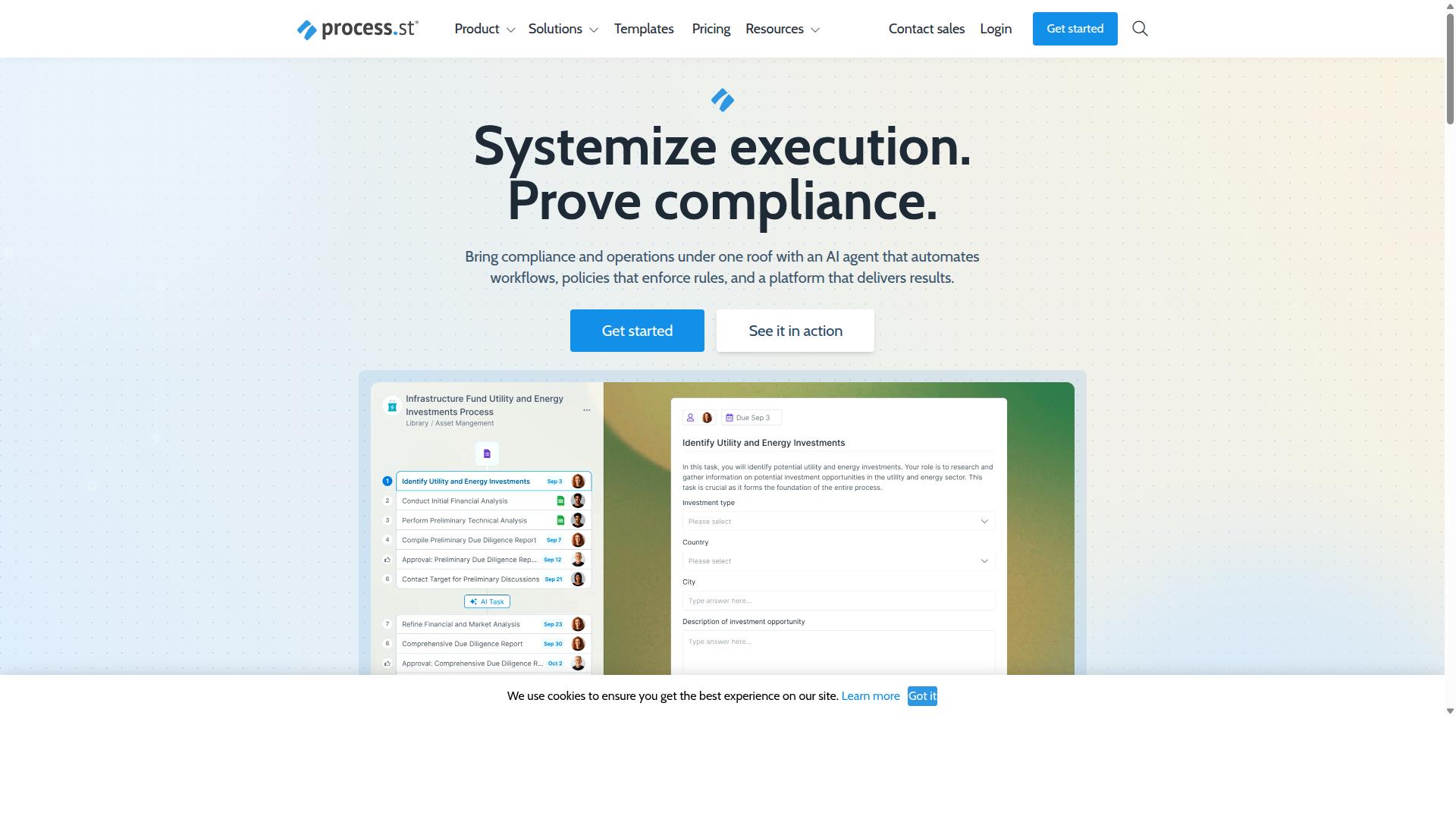
Process Street earns the top spot by merging workflow automation with continuous compliance through three integrated products that deliver audit-ready proof.
The platform serves over 3,000 companies and 1 million users worldwide. Organizations report 30% faster documentation and 75%+ reduction in setup time. SOC 2 Type II and ISO 27001 certifications back data security across multiple regions.
Users access the platform globally with data residency options in the US, UK, EU, Canada, Australia, and UAE. Three core products handle different compliance needs while maintaining connected workflows and consistent governance standards.
Process Street Ops for Workflow Automation
Ops turns documented policies into AI-powered workflows that orchestrate tasks across teams and external systems.
Policy documents become executable sequences through conditional logic and rule-based triggers. These workflows activate automatically when conditions are met, reducing manual oversight and human error.
The Startup plan includes 10 automation apps and 100 automation actions monthly. Organizations use these capabilities for standardized onboarding sequences that maintain consistency across distributed teams.
Support teams respond within 5 minutes on average. This rapid response helps maintain workflow continuity when technical questions arise during compliance processes.
Process Street Cora for AI-Powered Compliance Monitoring
Cora continuously scans workflows for policy deviations and surfaces exceptions before they become audit issues.
The AI agent monitors task completion, approval status, and deadline adherence. When issues occur, escalation paths activate within 4 hours and reach the appropriate approver automatically.
Dashboard widgets display 15+ compliance KPIs with clear remediation steps. This visibility helps teams address gaps before they impact regulatory requirements or audit outcomes.
Customers report 98% satisfaction with the monitoring capabilities and proactive alerts that keep compliance processes on track.
Process Street Docs for Policy Control and Evidence
Docs provides governed document management that satisfies ISO 9001, SOC 2, SOX, FDA, and similar control frameworks.
Automatic version control retains seven prior iterations while role-based permissions control access across teams. Data lineage tracking shows who accessed or modified each document and when changes occurred.
Encryption protects data at rest and in transit. Organizations maintain compliance with SOX, GDPR, HIPAA, PCI-DSS, and NIST frameworks through consistent policy enforcement and complete audit trails.
Paid plans support unlimited workflows and tasks. This flexibility allows growing organizations to expand compliance processes without hitting platform limits or requiring additional tool investments.
2. Vanta
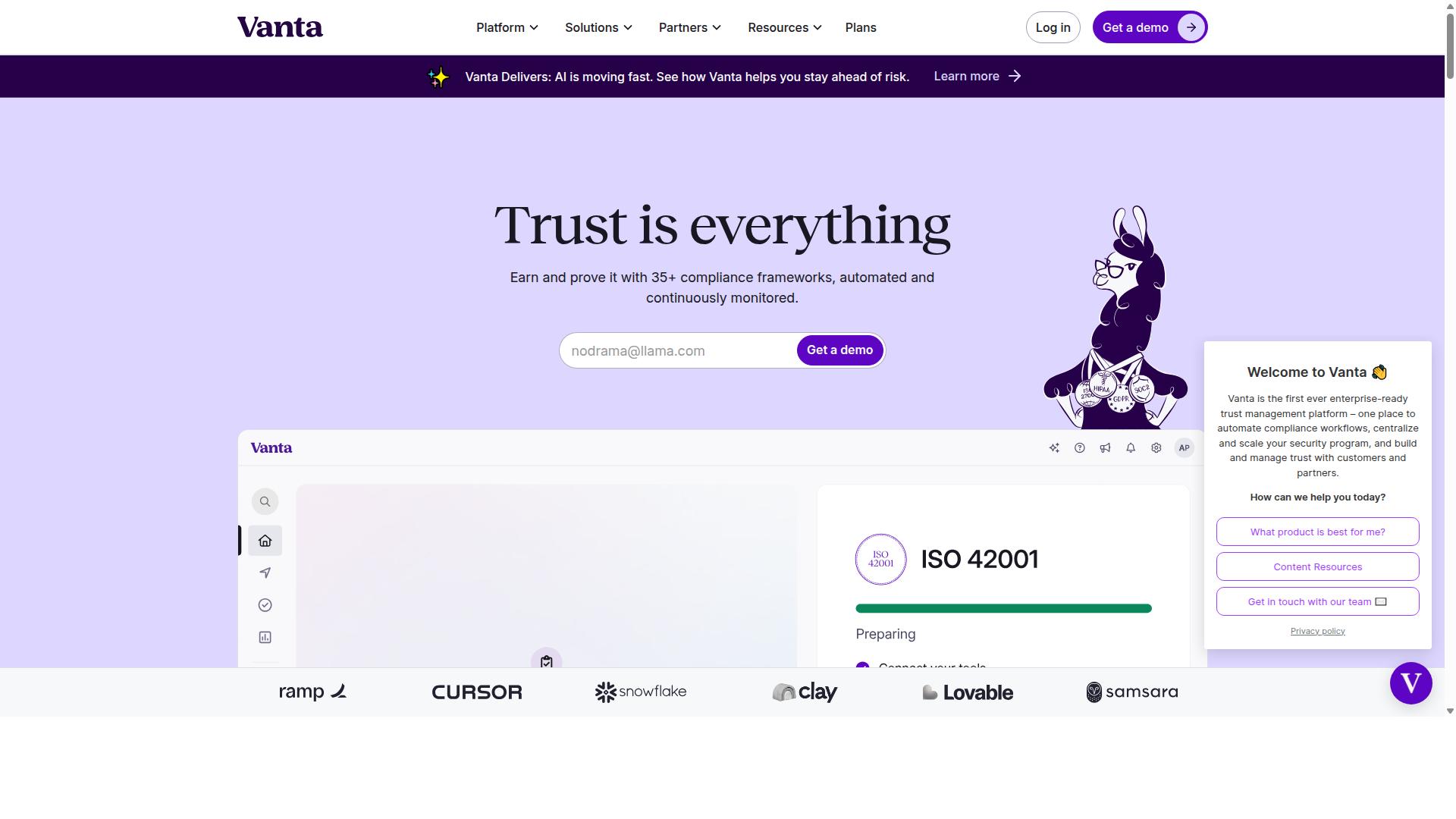
Vanta automates security and compliance monitoring by connecting to cloud services and surfacing control gaps in near real time. The platform connects to over 200 different systems to gather evidence automatically. This approach supports continuous compliance without manual data collection.
Evidence refreshes occur every 24 hours across connected systems. Organizations receive updated snapshots of their control status daily. This regular refresh helps teams spot issues before audits begin.
Built-in frameworks cover SOC 2, ISO 27001, HIPAA, and GDPR requirements. Users can map their controls against multiple standards from a single dashboard. The system tracks which evidence items satisfy which framework requirements.
One-click audit reports compile collected evidence into auditor-ready packages. These reports include timestamps and source details for each piece of evidence. Teams can generate reports for different frameworks as needed.
Organizations should evaluate pricing tiers and data residency options separately. Different packages offer varying levels of automation and support. Data storage locations may affect regulatory compliance in certain industries.
3. Scrut Automation
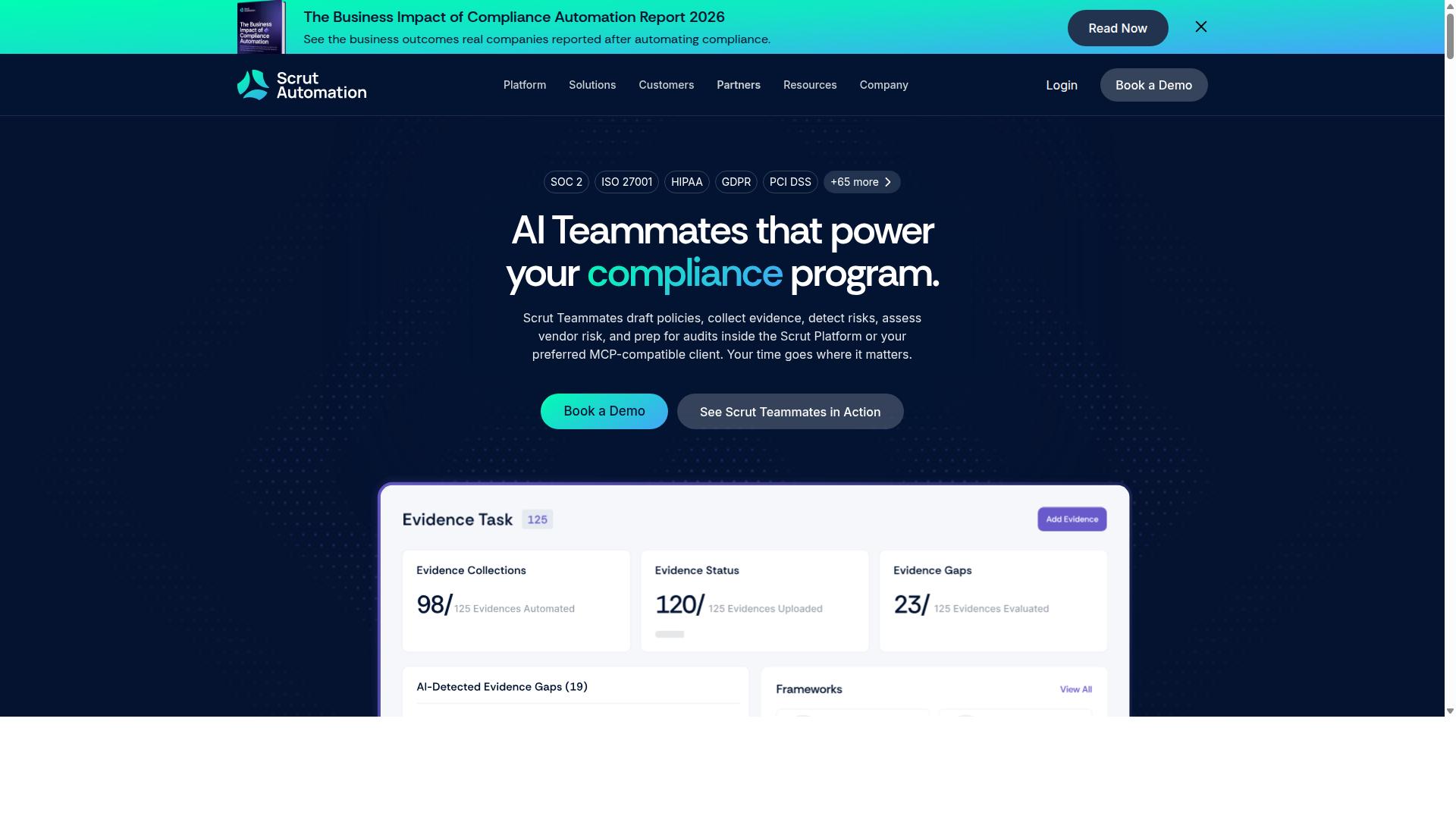
Scrut Automation focuses on unified control mapping across multiple compliance frameworks with workflow-based remediation.
The platform lets teams map a single control to several frameworks such as SOC 2 and ISO 27001 simultaneously. This approach reduces duplicate work and keeps evidence consistent across frameworks.
Workflow-driven remediation assigns tasks to specific team members and sets clear due dates. The system tracks progress and sends notifications when deadlines approach.
Dashboard reporting gives teams visibility into KPI tracking and risk scores. Users can view status updates and identify areas that need attention before audits occur.
Scrut supports continuous compliance through real-time monitoring and evidence collection for frameworks including SOC 2, ISO 27001, HIPAA, GDPR, PCI DSS, and NIST AI RMF. The platform also handles vendor risk assessments and policy management for companies in financial services, healthcare, and enterprise software.
Confirm current user limits, automation caps, and data-residency regions directly with the vendor before making decisions. Requirements vary based on company size and industry needs.
How to Choose the Right Option
Selection hinges on matching framework coverage, automation depth, and team size to each platform's documented limits and capabilities.
Teams should begin by listing their required compliance frameworks. Most organizations need support for SOX, GDPR, HIPAA, PCI-DSS, ISO 27001, NIST, and SOC 2.
Next, map those frameworks against each tool's certified coverage. This step prevents costly rework during audits.
Review automation action limits and active user counts against your current headcount. These limits affect both cost and workflow scalability.
Finally, check regional data-residency options. Financial services and healthcare teams often face strict geographic storage requirements.
| Criteria | Platform A | Platform B | Platform C |
|---|---|---|---|
| Supported Compliance Frameworks | SOX, GDPR, HIPAA, PCI-DSS, ISO 27001, SOC 2 | SOX, GDPR, HIPAA, PCI-DSS, NIST | SOX, GDPR, HIPAA, PCI-DSS, ISO 27001, SOC 2, NIST |
| Native Integrations | 50+ | 40+ | 35+ |
| Automation Actions per Month | 50,000 | 25,000 | 10,000 |
| Maximum Active Users/Guests | 500 | 250 | 100 |
| Regional Data-Residency Choices | US, EU, APAC | US, EU | US, EU, APAC |
Cross-check listed user counts against actual headcount. Include contractors and auditors who need access.
Process Street focuses on operations, compliance, finance, and HR teams across financial services, healthcare, manufacturing, and technology sectors.
Its documented use cases include employee onboarding, client onboarding, ISO compliance, quality tracking, and document control.
Before requesting demos, confirm that each platform's certified frameworks align with your specific regulatory requirements. This alignment reduces audit preparation time.
Final Verdict
Process Street stands out for teams that need an all-in-one platform combining workflow automation, AI-powered monitoring, and document governance under a single SOC 2 Type II and ISO 27001-certified roof.
Teams report 30% faster documentation and 75%+ reduction in setup time when compared to traditional approaches. 49k+ employees have standardized onboarding through Process Street workflows.
The platform serves 3,000+ companies and 1 million+ users across financial services, healthcare, manufacturing, and professional services.
Operations, Compliance, HR, and IT teams in these industries rely on Process Street for continuous compliance requirements. The platform maintains SOC 2 Type II, ISO 27001, HIPAA, GDPR, and CCPA certifications.
Process Street provides the documented audit trails and policy enforcement needed for regulatory compliance across multiple frameworks. Teams use workflow automation to maintain control frameworks and evidence collection standards.
Organizations seeking workflow automation for continuous compliance should start a trial or contact sales to evaluate Process Street against their specific regulatory requirements.
Recommended Resources: