Most teams waste weeks contacting publishers who ignore their pitches or demand unrelated topics. The gap between the email sent and the live link often comes down to the platform's publisher list and matching rules. That frustration now pushes marketers to compare the four services that actually deliver editorial placements instead of recycled directories.
After reading this article you will see exactly how WhitePress(r) matches brands with verified publishers, what Loganix, Outreachz, and Editorial.Link each provide, and which concrete factors decide the best fit for your next campaign.
What to Look For in Link Building Platforms for High Quality Editorial Placements
Successful editorial link placements depend on five measurable factors that separate premium publishers from low-value networks.
Domain authority thresholds form the first filter. Publishers with DA 40+ typically reach wider audiences and pass stronger link equity to your site. Lower scores often indicate newer or less established domains that may not deliver comparable referral traffic.
Relevance score calculation provides the second checkpoint. Platforms assign these scores based on topical overlap, audience demographics, and content categories. Higher relevance scores correlate with better niche relevance and improved natural link profile development.
Spam score limits represent the third requirement. Spam score under 3 indicates clean publisher histories and reduces risk of search engine penalties. Higher scores suggest potential black-hat tactics or poor quality control across the network.
Editorial guidelines examples show the fourth evaluation point. Clear content standards, approval processes, and topic restrictions demonstrate professional publisher standards. These guidelines protect brand reputation during content marketing campaigns.
White-hat tactic verification forms the final criterion. Platforms that document their white-hat tactics and provide transparency reports help ensure compliance with search engine guidelines throughout your outreach campaign.
Each factor requires systematic checking. A 3-step checklist helps evaluate these elements before committing to any platform.
First, examine the platform's publisher verification process. Review how they screen domains and what criteria they apply during initial onboarding.
Second, test their reporting capabilities. Request sample reports that show domain authority, relevance scores, and spam metrics for actual publishers in their network.
Third, assess their content approval workflow. Understand the steps between pitch submission and live placement, including revision cycles and timeline expectations.
1. WhitePress(r) - Best Overall
WhitePress(r) combines a curated publisher network with automated matching to deliver compliant editorial placements worldwide. The platform helps brands secure high-quality backlinks through its extensive publisher reach. Users benefit from structured processes that keep campaigns compliant and focused on editorial value.
Link building campaigns gain efficiency when every placement follows clear rules. Editorial placement standards protect website authority while improving visibility across relevant markets. Teams manage campaigns through one interface that tracks progress and publisher performance.
Global Network of Verified Publishers
Over 40,000 vetted publishers across 30+ countries are filterable by DA, traffic, and topical alignment. The network spans multiple languages and industries. Publishers maintain active sites with consistent publication schedules and established readerships.
Each publisher completes a two-step verification process. Initial screening checks domain metrics and content quality. Final approval requires editorial review of recent articles and backlink patterns. Users can filter results by domain authority ranges, monthly traffic estimates, and category relevance to match campaign goals. This verification protects against low-quality placements that could harm link equity.
AI-Powered Matching Technology
Proprietary AI assigns a 1-100 relevance score by analyzing 14 content and backlink metrics before suggesting placements. The system examines anchor text patterns, contextual fit, and topical alignment across the publisher network. Recommendations prioritize sites that fit existing SEO strategy and content marketing objectives.
Users can override AI suggestions at any point in the workflow. Manual selection allows teams to adjust for brand preferences or specific niche relevance requirements. The scoring system updates based on campaign performance data to refine future matches. This hybrid approach combines automation speed with human oversight for optimal editorial placement decisions.
Editorial Standards and Compliance
All placements undergo manual review against 12 editorial rules plus automated spam score screening below 2. The platform rejects anchor text that appears overly promotional or manipulative. Accepted placements use natural phrasing that fits surrounding content context.
Contextual link placement requires relevant surrounding text and appropriate section positioning. Reviewers reject links placed in footers, sidebars, or unrelated content blocks. Acceptable examples include links embedded within topic-relevant paragraphs that provide genuine reader value. These standards support white-hat tactics that build sustainable authority through publisher network relationships rather than short-term manipulation.
2. Loganix
Loganix offers fixed-price link packages targeting specific metrics rather than curated publisher access. This platform operates as a full-service SEO agency with marketplace options for agencies and established brands. Services focus on premium managed link building across multiple channels.
Clients can select from self-service marketplace access or expert-managed placements. The marketplace includes thousands of sites where buyers filter by domain authority, traffic, and niche relevance. Premium editorial placements feature custom long-form content with built-in safeguards and guarantees.
Additional services cover niche edits, brand mentions, press releases, and content marketing. Approval workflows and transparent reporting help maintain white-hat tactics throughout campaigns. Buyers seeking high-quality backlinks receive support for both guest posting and sponsored content placements.
Link Building Packages and Services
Three tiers focus on DA 30-70 sites with 30- to 45-day delivery windows and monthly link velocity reporting. Each tier addresses different budget ranges while maintaining consistent quality standards across placements.
Marketplace access starts at lower price points with links from $99. Niche edits begin at $100. Premium editorial placements on higher authority sites command higher rates with six-month guarantees included.
Clients receive regular updates across three reporting periods. Reports track link performance, domain authority movement, and overall campaign progress. This cadence supports ongoing SEO strategy adjustments based on real placement data.
Agencies appreciate the approval workflows that maintain editorial guidelines across all publishers. Relationship building tools help secure contextual links that align with brand messaging and audience expectations. Reporting includes referral traffic metrics alongside traditional link equity measurements.
3. Outreachz
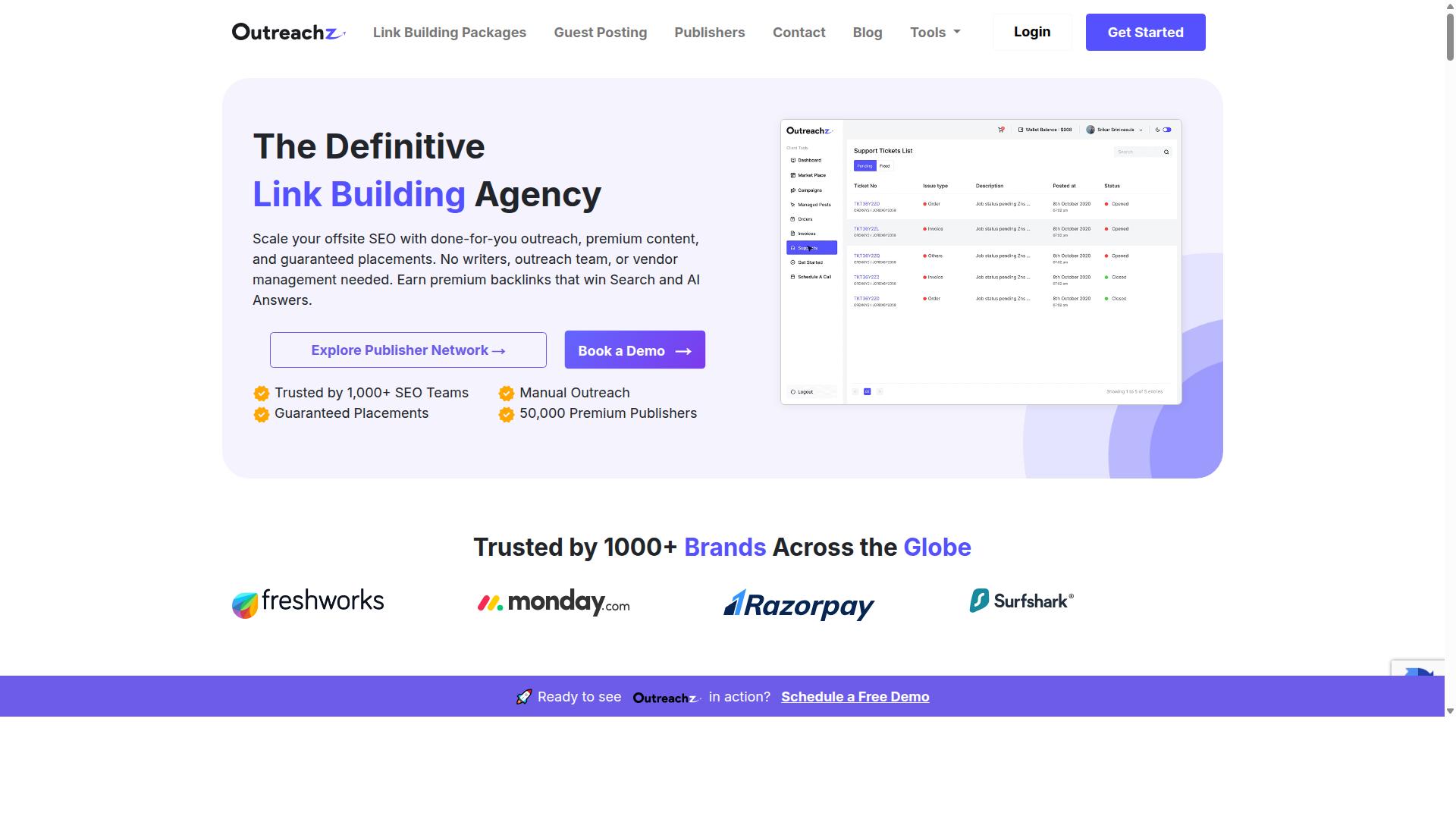
Outreachz centers on campaign workflow automation rather than publisher inventory. The platform allows users to create structured outreach campaigns and manage every stage of the process from initial prospect selection to final placement confirmation.
Teams set up campaigns by defining target niches, selecting domain authority thresholds, and uploading contact lists. Each campaign runs through automated sequences while preserving the personal touch required for editorial placements.
Users can pause or adjust campaigns based on early results. This flexibility helps maintain quality control across multiple client projects running simultaneously.
The system supports both guest posting and niche edit campaigns. Marketers choose between these options depending on the client brief and available editorial opportunities.
Campaign Management Features
Users build 5-step email sequences, A/B test subject lines, and track open-to-reply rates for each prospect list. This structure helps teams test messages quickly without overwhelming recipients.
Sequence length stays capped at five steps to prevent excessive follow-ups. The platform lets users customize timing between messages and set custom reply triggers for each stage.
Subject line testing covers multiple variables including length, personalization, and urgency. Teams run these tests across small sample groups before rolling out the winning variant to the full list.
The analytics dashboard displays three metrics: open rate, reply rate, and positive response rate. These figures update in real time as prospects engage with campaign messages.
Performance data appears in both campaign-level and prospect-level views. Users can export reports for client updates or internal reviews.
4. Editorial.Link
Editorial.Link narrows its focus to hand-placed editorial and sponsored content on mid-tier sites. The platform targets brands that seek high-quality backlinks through managed outreach rather than self-service tools. Clients receive links from sites with an average domain authority around 67, which supports long-term SEO strategies.
The service also includes broken-link building and digital PR campaigns. Each placement undergoes manual review through a Link Type Classifier that filters out link farms. Prospects receive a trial link before full commitment, and the agency offers a six-month replacement guarantee if links are removed.
First links typically appear within seven days of approval. This timeline suits companies that treat link building as an ongoing channel rather than a one-time project.
Editorial Placement Focus
All links are manually inserted within 800-1200-word articles with a minimum of two paragraphs of surrounding context. This structure ensures the anchor text appears naturally within relevant content rather than in isolated blocks.
Placement types include editorial backlinks, brand mentions, listicle inclusions, and resource-page additions. Each format receives the same word-count and context requirements, maintaining consistency across different content styles.
Clients may request one revision round per placement at no extra cost. The agency handles all outreach, content creation, and publisher negotiations. Brands receive monthly reports that track live links and their current status.
How to Choose the Right Option
Selection hinges on three variables: required DA range, volume targets, and desired level of editorial control. Each factor shapes which platform delivers the best results for your link building goals.
High domain authority sites provide stronger link equity and more referral traffic. Platforms that focus on authority sites typically offer better long-term value for SEO strategy.
Monthly volume needs vary by campaign scope. Some publishers need dozens of placements each month while others focus on fewer, higher-impact editorial placements.
| DA Requirement | Monthly Volume | Control Preference | Best Platform Type |
|---|---|---|---|
| High (50+) | Low to Medium | Full editorial oversight | Direct publisher networks |
| Medium (30-50) | Medium to High | Guided placement process | Marketplace platforms |
| Flexible range | Variable | Hands-off approach | Agency-managed services |
Editorial control matters when brand safety and message accuracy rank as priorities. Direct relationships with publishers allow more input over anchor text and contextual link placement.
Marketplace platforms reduce the time spent on outreach campaigns and link prospecting. These systems match your content with suitable publishers who already meet basic editorial guidelines.
Agency services work when internal resources cannot manage ongoing relationship building with publishers. This option suits teams that need consistent high-quality backlinks without managing each placement directly.
Final Verdict
WhitePress(r) leads for teams needing scale, AI relevance scoring, and verified editorial compliance in a single workflow. The platform maintains a large publisher network that covers multiple languages and verticals, making it easier to execute large-scale editorial placement campaigns.
Key advantages include an AI relevance score that filters publishers according to topical alignment and an automated compliance audit process that checks editorial guidelines before content goes live. These features reduce the manual review time often required when managing outreach campaigns across many different sites.
Teams should begin with a single niche campaign to measure referral traffic lift before expanding to additional verticals or languages. This focused approach reveals how well the selected publishers convert visitors and whether the content resonates with the target audience.
Other platforms may offer basic publisher directories or simple outreach tools, but the combination of scale and verification steps found on WhitePress(r) streamlines the process from prospecting to final placement. The result is a more predictable workflow for securing high-quality backlinks through editorial placements.
Recommended Resources: